Cubic Zirconia Is Not a Diamond
Cubic zirconia (CZ) is a synthetic material made from zirconium dioxide (ZrO₂). It is classified as a diamond simulant, meaning it is designed to imitate the appearance of a diamond without sharing its physical or chemical properties.
A lab grown diamond, on the other hand, is a real diamond. It has the same carbon crystal structure, brilliance, hardness, and optical performance as a mined diamond.
That means a lab grown diamond is not “diamond-like” – it is chemically and structurally identical to a natural diamond.
You can also read:
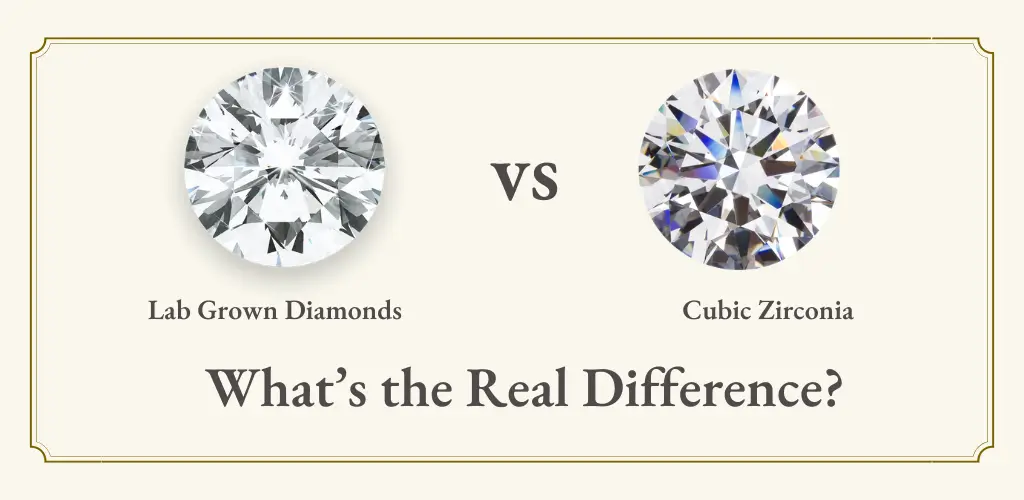
Appearance: Sparkle That Looks Real
One of the biggest visual differences in lab grown diamonds vs cubic zirconia is how each stone handles light. When brand-new, high-quality cubic zirconia can look convincing in low light or from a distance. This is why CZ is commonly used in fashion jewellery.
But under bright lighting or daily wear, the differences become obvious.
Cubic Zirconia
- Produces excessive rainbow flashes
- Has a softer, glassy appearance
- Lacks the crisp scintillation of a real diamond
- Can appear artificial over time
Lab Grown Diamonds
- Reflect light exactly like mined diamonds
- Produce balanced brilliance and fire
- Have sharp, clean scintillation
- Maintain their sparkle permanently
The biggest difference in the lab grown diamonds vs cubic zirconia comparison is realism. A lab grown diamond behaves like a diamond because it is one.
Durability: The Difference Daily Wear Reveals
When comparing lab grown diamonds vs. cubic zirconia, durability is one of the most important factors to consider.
Mohs Hardness Scale
- Cubic Zirconia: 8-8.5
- Diamond: 10
Diamonds are the hardest natural material on Earth. This matters because engagement rings are exposed to constant friction, dust, impact, lotions, soap, and everyday wear.
CZ scratches relatively easily. Over time, its surface becomes cloudy and loses brilliance. Many cubic zirconia rings begin to dull within months of regular use.
A lab grown diamond retains its polish, sparkle, and structural integrity indefinitely.
If you want jewellery that still looks beautiful years later, durability matters far more than initial appearance.
Price Difference: Why the Gap Exists
The pricing gap between lab grown diamonds vs cubic zirconia exists because the two stones are fundamentally different in quality and longevity.
Typical Pricing
- 1-carat-equivalent CZ: ₹200-₹1,000
- 1-carat lab grown diamond: ₹30,000-₹80,000
At face value, the difference seems enormous. But these are not equivalent products.
CZ is inexpensive because:
- It scratches easily
- It loses brilliance
- It has no rarity or intrinsic material value
- It is mass-produced for costume jewellery
Lab grown diamonds cost more because they are real diamonds with permanent durability and genuine fine jewellery value.
For many buyers, a smaller real diamond is a better long-term choice than a larger simulant stone.
For example, a beautifully cut 0.50 carat lab grown diamond will outperform a 1 carat CZ in brilliance, longevity, and overall luxury feel.
Certification: One Is Certified as a Diamond
Another important distinction in lab grown diamonds vs cubic zirconia is certification and authenticity.
Lab grown diamonds can be certified by leading gemological laboratories such as IGI and GIA.
These certificates evaluate:
- Cut
- Colour
- Clarity
- Carat weight
- Authenticity
Cubic zirconia cannot receive diamond certification because it is not a diamond.
This distinction becomes important when purchasing engagement jewellery, especially for transparency and long-term confidence.
When Cubic Zirconia Makes Sense
CZ still has practical uses depending on the purpose of the jewellery.
Cubic zirconia works well for:
- Fashion jewellery
- Occasional wear
- Travel or backup rings
- Costume jewellery
- Temporary placeholder rings
If the goal is short-term style at the lowest possible price, CZ can be reasonable.
When Cubic Zirconia Does Not Make Sense
For jewellery intended to last years or decades, cubic zirconia becomes far less practical.
CZ is not ideal for:
- Engagement rings
- Daily wear jewellery
- Heirloom pieces
- Long-term fine jewellery
- Purchases where lasting brilliance matters
Over time, repeated replacement often makes CZ less economical than buyers initially expect.
The Better Choice for an Engagement Ring
For engagement rings, the debate around lab grown diamonds vs cubic zirconia is ultimately about permanence versus temporary appearance.
The right answer depends on what you want from the ring.
If you want a ring with temporary sparkle for minimal cost, cubic zirconia can work.
But if you want:
- A real diamond
- Lasting brilliance
- Everyday durability
- Fine jewellery quality
- A ring that still looks beautiful decades later
- Certified by gemological laboratories such as IGI and GIA.
Then a lab grown diamond is in an entirely different category.
At Rossia, we believe an engagement ring should feel meaningful, permanent, and authentic – not disposable.
A smaller real diamond will almost always age more beautifully than a larger simulant stone.
Keep Reading
You may also like: