What Is Jewellery Craftsmanship?
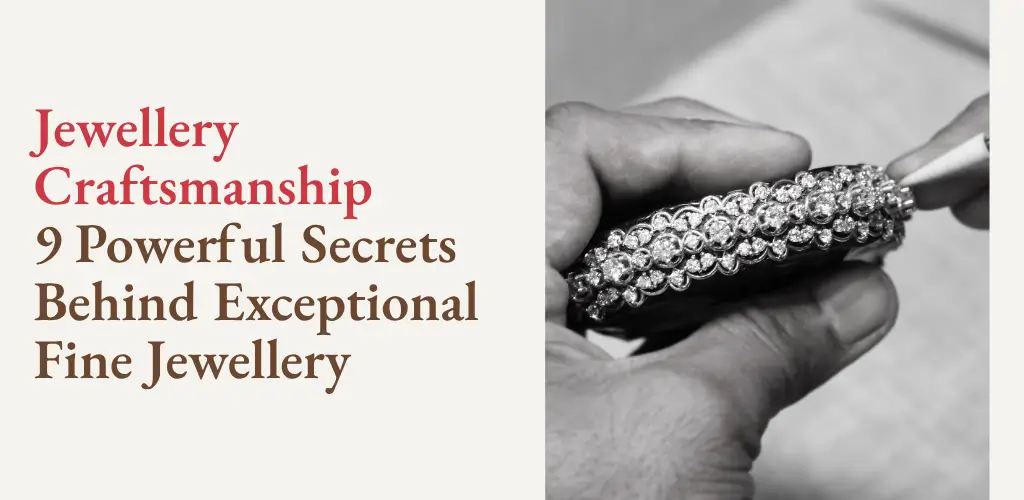
Jewellery craftsmanship combines technical skill, artistic judgment and attention to detail used to transform precious metals and gemstones into finished jewellery.
It covers every stage of creation – from designing and modelling to casting, metalwork, diamond setting, assembly, polishing and final quality checks.
Good jewellery craftsmanship is not simply about making a piece look attractive. It is about creating the right balance between:
- Beauty
- Strength
- Comfort
- Proportion
- Precision
- Functionality
- Long-term durability
For example, an engagement ring may look perfect from the top, but its true quality shows in the symmetry of the setting, the finishing underneath the stone, the thickness of the band and the security of the prongs.
That attention to detail – both visible and invisible – is what separates ordinary jewellery from fine jewellery.
Why Does Jewellery Craftsmanship Matter So Much?
Jewellery is often purchased to mark important moments – engagements, weddings, anniversaries, birthdays or personal milestones.
That means the piece is expected to last much longer than a passing fashion trend.
Quality jewellery craftsmanship directly influences how a piece performs over time. A well-crafted ring should hold its shape, a properly set diamond should remain secure, and polished surfaces should maintain their finish with appropriate care.
Poor craftsmanship, on the other hand, can lead to problems such as:
- Loose diamonds or gemstones
- Uneven prongs
- Weak joints
- Rough or sharp edges
- Uneven polishing
- Uncomfortable settings
- Metal deformation
- Stones becoming vulnerable to damage
This is why price alone should never be the only factor when choosing fine jewellery.
How Is Fine Jewellery Made?
Creating a piece of fine jewellery involves several carefully coordinated stages.
While the exact process depends on the design, the journey generally includes:
Concept → Design → CAD Modelling → Wax/Resin Model → Casting or Fabrication → Finishing → Diamond Setting → Polishing → Quality Inspection
Every stage requires its own expertise.
Modern jewellery manufacturing combines technology with the experience of skilled artisans. CAD software can help create highly precise designs, but experienced craftsmen are still essential for setting stones, refining surfaces, correcting minute imperfections and giving the final piece its character.
At Rossia Jewels, this combination of modern technology and skilled manufacturing expertise allows us to create jewellery that balances contemporary design with dependable construction.
What Skills Are Essential in Jewellery Craftsmanship?
Creating fine jewellery requires expertise across multiple disciplines.
-
Metalworking
Gold and other precious metals need to be shaped with precision. Depending on the design, craftsmen may use techniques such as casting, soldering, forging, filing and fabrication.
The objective is not simply to create the desired shape but to ensure that the structure is strong enough for its intended use.
-
Diamond and Gemstone Setting
Setting is one of the most important stages in jewellery making.
A diamond must sit correctly within its setting, with the right amount of metal securing it without compromising its appearance.
Common setting styles include:
- Prong setting
- Bezel setting
- Pavé setting
- Channel setting
- Halo setting
- Invisible setting
The right setting depends on the gemstone, design, lifestyle and desired appearance.
-
Polishing and Finishing
Once the jewellery is assembled and the stones have been set, the piece goes through detailed finishing.
Polishing removes tiny surface imperfections and creates the desired shine. Depending on the design, a piece may feature high-polish, matte, brushed or textured finishes.
Edges also need to be smooth and comfortable, particularly on pieces designed for everyday wear.
-
Quality Inspection
Before a piece reaches the customer, it should be carefully inspected.
Craftsmen and quality teams check details such as stone security, alignment, symmetry, finishing, dimensions and overall construction.
These final checks are an essential part of professional jewellery manufacturing.
How Do Diamonds and Gemstones Depend on Craftsmanship?
Even an excellent diamond needs the right setting to reach its visual potential.
A gemstone’s position, angle and security can influence how it interacts with light. At the same time, the setting needs to protect the stone from unnecessary impact.
For example, a prong setting needs carefully proportioned prongs. They should hold the diamond securely while allowing sufficient exposure to light.
With pavé jewellery, the spacing and alignment of multiple small diamonds require exceptional precision.
This is why jewellery craftsmanship plays an important role even when the gemstone itself is the centre of attention.
Does Craftsmanship Matter More Than Design?
Design and craftsmanship work together.
A creative design gives jewellery its visual identity, while craftsmanship determines whether that design can be successfully translated into a wearable, durable piece.
A beautiful design with poor construction may look impressive initially but fail to provide the comfort and durability expected from fine jewellery.
On the other hand, excellent craftsmanship can elevate a relatively simple design through:
- Better proportions
- Cleaner lines
- Precise stone placement
- Comfortable edges
- Refined finishing
- Stronger construction
At Rossia Jewels, our approach starts with understanding the design intent and then translating it into a piece that is practical, wearable and beautifully finished.
Is Handmade Jewellery Always Better Than Machine-Made Jewellery?
Not necessarily.
The difference between handmade and machine-assisted jewellery is more nuanced than simply deciding which is “better.”
Modern jewellery manufacturing uses technology to improve precision and consistency. CAD modelling, 3D printing and advanced casting techniques allow complex designs to be developed accurately.
However, machines do not eliminate the need for skilled artisans.
Processes such as diamond setting, finishing, polishing, assembly and final corrections still depend heavily on human judgment.
The best modern jewellery often combines technology for precision with craftsmanship for refinement.
How Does CAD Technology Improve Jewellery Making?
CAD, or Computer-Aided Design, has transformed the way jewellery is developed.
Before manufacturing begins, designers can create a detailed digital model of a piece. This allows them to evaluate:
- Dimensions
- Proportions
- Stone placement
- Band thickness
- Setting structure
- Overall appearance
Design changes can also be made before the physical manufacturing process begins.
This is particularly valuable for custom jewellery, where the design needs to be created around an individual’s preferences.
However, CAD is only one part of the process. The final piece still needs skilled manufacturing and finishing to become jewellery you can actually wear.
What Is the Difference Between Mass-Produced and Fine Jewellery?
Mass production focuses heavily on consistency, scalability and production efficiency.
Fine jewellery requires another layer of attention.
The distinction isn’t necessarily that one is made by machines and the other entirely by hand. Instead, it often comes down to the level of design control, material selection, finishing and quality inspection involved in the final piece.
Fine jewellery manufacturing pays close attention to details that may otherwise be overlooked, particularly when a piece is custom-made or contains valuable gemstones.
This is where an experienced jewellery manufacturer can make a significant difference.
How Can You Identify Good Jewellery Craftsmanship?
You don’t need to be a jewellery expert to spot several signs of quality.
When buying a ring, bracelet, necklace or pair of earrings, look closely at:
Symmetry
Does the design look balanced from different angles?
Stone Alignment
Are the diamonds or gemstones evenly positioned?
Prongs
Are prongs consistent, properly finished and securely holding the stone?
Edges
Do the edges feel smooth rather than sharp or rough?
Finishing
Does the metal have an even, refined surface?
Joints
Are connections clean and properly finished?
Comfort
Does the jewellery sit comfortably when worn?
These small details can reveal a great deal about the manufacturing quality behind a piece.
What Are the Warning Signs of Poor Craftsmanship?
Some problems may be difficult to notice at first, but they can become significant over time.
Watch out for:
- Uneven or poorly finished prongs
- Loose stones
- Visible gaps
- Rough edges
- Uneven diamond spacing
- Weak-looking bands
- Poorly aligned design elements
- Inconsistent polishing
- Visible solder marks
These aren’t merely cosmetic concerns. Depending on the issue, they can affect the durability and safety of the jewellery.
Choosing a trusted jeweller and manufacturer can help reduce these risks.